
Swoop Card Game Rules: A Comprehensive Guide
Swoop is a fun, fast-paced card game for 3-8 players, aiming to discard all cards first. Numerous online resources, including PDFs, detail setup, gameplay, scoring, and reaching 500 points!
Overview of Swoop
Swoop is a dynamic card game designed for 3 to 8 players, utilizing between 3 and 5 standard decks of cards. The core objective revolves around being the first player to successfully eliminate all 19 cards from their hand and tableau during a single round. This game blends elements of strategy and quick thinking, making it accessible to a wide age range, from 7 to 97 years old.
The gameplay centers around strategically playing cards onto a central discard pile, adhering to specific rules regarding card sequences and special actions. Players manage a hand of cards alongside face-up and face-down cards arranged in front of them, adding a layer of complexity to decision-making. Numerous online resources, often available as downloadable PDFs, provide comprehensive guides to the game’s intricacies.
These guides typically cover everything from initial setup and dealing procedures to detailed explanations of special card actions and scoring mechanisms. The ultimate goal isn’t just to empty your hand, but to accumulate points over multiple rounds, with the first player to reach 500 points declared the winner. Swoop offers a blend of simplicity and strategic depth, ensuring an engaging experience for both casual and seasoned card game enthusiasts.
What is Swoop?

Swoop is a captivating card game characterized by its straightforward rules and engaging gameplay, making it easily accessible to players of all skill levels – from beginners to experienced card game aficionados. The game centers around swiftly discarding cards onto a communal discard pile, demanding quick reflexes and strategic thinking. It’s designed for 3-8 players, utilizing multiple decks to enhance the dynamic play.
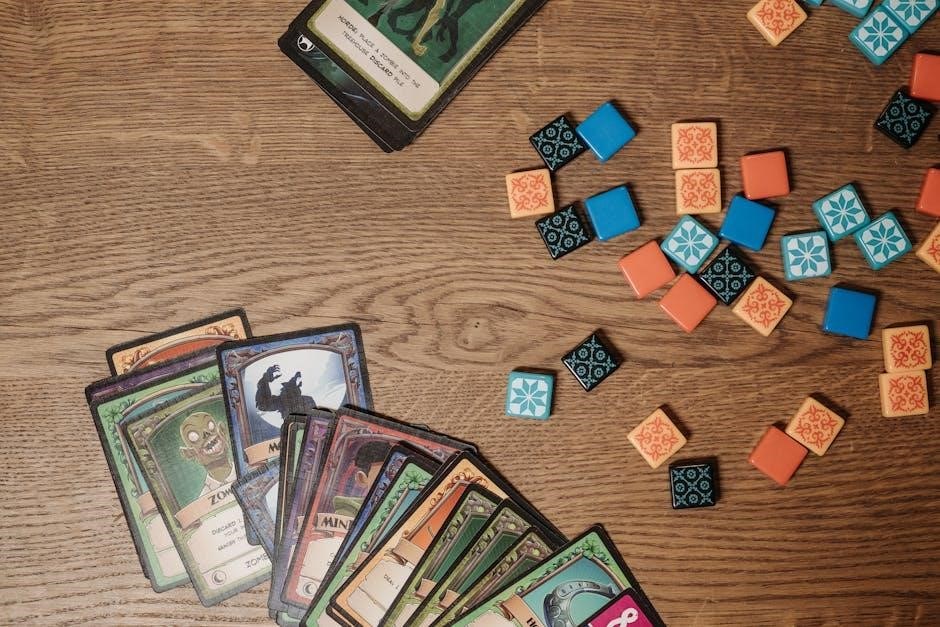
At its heart, Swoop is a game of pattern recognition and tactical card play. Players manage a hand of cards, alongside a personal tableau of face-up and face-down cards, constantly evaluating opportunities to shed their holdings. Special card actions introduce an element of surprise and disruption, adding layers of complexity to the game.
Detailed instructions and comprehensive rule sets are readily available online, often in convenient PDF format. These resources guide players through the setup, gameplay mechanics, scoring procedures, and ultimately, the path to victory – reaching a cumulative score of 500 points. Swoop provides a fun and competitive experience, perfect for family gatherings or game nights with friends.

Number of Players
Swoop is remarkably versatile regarding player count, accommodating a range of social gatherings. The game is optimally enjoyed with 3 to 8 players, providing a balanced and engaging experience for everyone involved. While playable with fewer than three, the dynamic and competitive element diminishes somewhat.
With three or four players, the game tends to be more strategic and deliberate, allowing for careful planning and observation of opponents’ moves. As the player count increases towards the maximum of eight, the pace quickens dramatically, demanding faster reflexes and more intuitive decision-making.
The number of decks used is often adjusted based on the number of players to ensure sufficient cards for all. Detailed Swoop rule sets, frequently found in PDF format online, will specify the appropriate deck count for different player numbers. Regardless of the group size, Swoop consistently delivers a fun and interactive card game experience, suitable for a wide spectrum of ages and skill levels.
Components of the Game
The core component of Swoop is, naturally, a standard deck (or multiple decks, depending on player count) of playing cards. Typically, 3 to 5 decks are utilized to ensure sufficient cards for all players, especially in larger groups. These decks should be complete, containing all 52 cards – including the Ace through King in each of the four suits: hearts, diamonds, clubs, and spades.
Beyond the cards themselves, no specialized game pieces or boards are required. Swoop is designed for portability and simplicity, making it ideal for travel or casual gatherings. A flat playing surface is, of course, necessary to arrange the cards effectively.
Many downloadable Swoop rule guides, often available as PDFs, will reiterate the necessity of standard playing cards and may offer recommendations regarding deck quantity based on the number of participants. Some versions may suggest using card sleeves to protect the cards from wear and tear, extending their lifespan. Ultimately, the game’s accessibility is a key feature, relying solely on readily available components.

Setting Up the Game
Preparation involves dealing cards to each player, establishing a discard pile, and arranging face-up and face-down cards. PDF guides detail precise dealing procedures for a smooth start to gameplay!
Dealing the Cards
The initial card distribution is crucial for a balanced Swoop game. Typically, each player receives 19 cards to begin. Detailed Swoop card game rules PDFs consistently emphasize this number as standard for a typical round, accommodating 3-8 players effectively. The dealer shuffles the deck – often utilizing 3-5 standard decks depending on the player count – and deals the cards one at a time, face down, in a clockwise direction.
After the initial deal, players arrange their hands, preparing for the first turn. Many instructional PDFs highlight the importance of quickly assessing your hand for potential plays. Following the initial hand distribution, each player places a specific number of cards face down in front of them, usually around 4-5 cards, forming their personal stock pile. Then, a smaller number, typically 3 cards, are placed face up alongside the face-down pile. These face-up cards are immediately available for play, adding a strategic element to the game. PDF guides often include diagrams illustrating this setup for clarity.
Understanding the dealing process, as outlined in readily available Swoop rules PDFs, is fundamental to enjoying a fair and engaging game. Correct dealing ensures everyone has an equal opportunity to compete and strategize effectively.
The Discard Pile
The discard pile is central to Swoop’s gameplay, serving as the destination for played cards and a key element in determining valid moves. Swoop card game rules PDFs universally illustrate its creation and function. It begins with a single card flipped from the remaining deck after dealing, initiating the pile. This starting card dictates the initial suit or rank players must attempt to match or exceed when taking their turns.
Throughout the game, players add cards to the discard pile by playing cards from their hand or face-up cards. The core mechanic revolves around playing a card that is either higher in rank or of the same rank but a different suit than the top card of the discard pile. PDF guides frequently emphasize that players must play a card if able, preventing strategic holding.
The discard pile isn’t static; it constantly evolves, presenting new challenges and opportunities. Understanding how cards accumulate and the implications for subsequent plays, as detailed in comprehensive Swoop rules PDFs, is vital for success. The pile’s history influences strategic decisions, making it a focal point for attentive players.
Face-Up and Face-Down Cards
A defining characteristic of Swoop is the arrangement of cards each player receives. Swoop card game rules PDFs consistently explain the initial deal: players are given a hand of cards held privately (face-down) alongside a set of cards dealt face-up on the table in front of them. This creates a unique blend of hidden and visible information, influencing strategic play.
Typically, players receive a specific number of face-down cards – often around 10-12 – forming their personal hand. Simultaneously, a smaller number, usually 7, are dealt face-up, accessible to all players. These face-up cards are crucial, offering immediate play options and potential targets for opponents. PDF guides highlight the importance of managing both sets effectively.
The interplay between face-up and face-down cards is central to Swoop’s strategy. Players must balance utilizing their visible cards for quick plays with conserving face-down cards for tactical advantages. Detailed Swoop rules PDFs often provide advice on prioritizing card usage based on game state and opponent actions, emphasizing adaptability.

Gameplay Mechanics
Swoop’s gameplay revolves around taking turns, strategically playing cards onto a central discard pile, and utilizing special card actions. PDF guides detail these mechanics for swift, engaging rounds!

Taking a Turn
Taking a turn in Swoop is a relatively straightforward process, but mastering the nuances is key to success. On your turn, you must attempt to play at least one card from your hand onto the central discard pile. You can play multiple cards if they meet the necessary criteria, as outlined in the comprehensive rule sets often found in downloadable PDF guides.

The core principle is matching either the rank or the color of the top card on the discard pile. For example, if a red 7 is showing, you can play any red card or any 7, regardless of color. If you have no playable cards, you are forced to draw a card from the draw pile. Your turn then ends, even if the drawn card is playable – you cannot play it on the same turn you drew it.

PDF rulebooks emphasize the importance of strategic card holding. Sometimes, it’s better to draw a card than to play a card that might benefit your opponents. Understanding the special card actions (detailed elsewhere) and anticipating your opponents’ moves are crucial elements of effective turn-taking. Remember to consult a Swoop card game rules PDF for a complete understanding of all turn-related regulations and clarifications.
Playing Cards to the Discard Pile
Playing cards to the discard pile is the central mechanic of Swoop. To legally play a card, it must match either the color or the rank of the top card currently visible on the discard pile. Detailed Swoop card game rules PDFs consistently highlight this fundamental rule. For instance, if the top card is a blue 5, you can play any blue card or any card with the rank of 5.
Multiple cards can be played on a single turn, provided each subsequent card adheres to the matching rule based on the new top card. This allows for potentially long chains of plays, accelerating the game. However, remember the restriction: a card drawn during your turn cannot be played on that same turn.
PDF guides often illustrate examples of legal and illegal plays, clarifying common misunderstandings. Strategic play involves not only discarding cards quickly but also considering how your plays might set up opportunities for yourself or hinder your opponents. Mastering this aspect, as explained in comprehensive rule PDFs, is vital for achieving victory in Swoop.
Special Card Actions
Swoop incorporates special card actions that add layers of strategy and unpredictability, thoroughly detailed in available Swoop card game rules PDFs. Certain cards, when played, trigger unique effects impacting gameplay. For example, some versions include a “Reverse” card, changing the direction of play, or a “Skip” card, forcing the next player to miss their turn.
A key element often found in rule PDFs is the “Swoop!” card. When played, all players simultaneously place a card face down. Cards are then revealed, and the player with the lowest rank must pick up all the revealed cards. This creates exciting moments of risk and reward.
Understanding these special actions, as clearly outlined in downloadable PDFs, is crucial for effective play. Strategic use of these cards can disrupt opponents, protect yourself, and ultimately contribute to reaching the winning 500-point threshold. Many guides emphasize memorizing the effects of each special card to maximize their impact during the game.

Winning the Game
Swoop is won by being the first to discard all cards, termed “going out.” Players continue rounds, scoring points until someone reaches 500, as detailed in Swoop card game rules PDFs.
Going Out
“Going Out” in Swoop signifies a player successfully discarding all nineteen of their cards – both those initially held in their hand and the face-up/face-down cards arranged in front of them. This achievement immediately ends the current round of play. It’s a pivotal moment, triggering the scoring phase where points are tallied for all players.
However, simply discarding the last card isn’t always enough! A player must legally play their final card onto the discard pile, adhering to the established gameplay rules regarding matching ranks or sequences. If a player attempts an illegal play as their final move, they are penalized and do not go out. Play continues until a legitimate “going out” occurs.
Many online Swoop card game rules PDFs emphasize the importance of strategic card management to facilitate a swift exit. Players should aim to create combinations and opportunities to shed cards efficiently, anticipating potential plays from opponents. Successfully “going out” not only secures points for the winning player but also prevents opponents from further accumulating cards and potentially scoring themselves. Mastering this aspect of the game is crucial for overall success, as detailed in comprehensive rule guides.
Scoring Points
Once a player successfully “goes out,” the scoring phase begins. Players who haven’t discarded all their cards tally points based on the cards remaining in their hands and those still face-up/face-down in front of them. Typically, number cards (2-10) are worth their face value. Face cards – Jacks, Queens, and Kings – generally carry a value of 10 points each.
Aces often present a unique scoring scenario, sometimes valued at 1 or 11 points, depending on the specific rules variant being played. Detailed Swoop card game rules PDFs will clearly outline the point values assigned to each card type. The player who “went out” receives a score of zero for that round.
The scores of all other players are then added together, and this total is awarded to the player who went out. Strategic play focuses not only on discarding cards quickly but also on minimizing the point value of the cards left in opponents’ hands. Understanding the scoring system, as explained in readily available rulebooks, is vital for maximizing your own score and hindering your rivals’ progress towards the 500-point victory threshold.
Reaching 500 Points
The ultimate goal in Swoop isn’t simply winning individual rounds; it’s accumulating a total of 500 points or more across multiple rounds of play. After each round’s scoring, players add the points they’ve earned to their cumulative totals. Play continues, round after round, until one player surpasses the 500-point mark.
Detailed Swoop card game rules PDFs often clarify what happens if multiple players exceed 500 points in the same round – typically, the player with the highest total is declared the overall winner. Strategic card play isn’t just about going out quickly; it’s about maximizing your point gains each round while simultaneously minimizing your opponents’ scores.
Consistent scoring and a keen awareness of the running totals are crucial for success. Some variations might introduce bonus points or penalties, so consulting a comprehensive rule guide is essential. Reaching 500 points signifies mastery of the game’s blend of speed, strategy, and a little bit of luck, crowning the ultimate Swoop champion!