
Boxing footwork drills, often found in PDF guides, are crucial for developing agility, balance, and ring generalship. Mastering these techniques enhances both offense and defense.
The Importance of Footwork in Boxing
Footwork is undeniably the cornerstone of success in boxing, often emphasized within boxing footwork drills PDF resources. A fighter’s ability to move efficiently dictates their capacity to land punches, evade attacks, and control the ring. Without solid footwork, even the strongest punches become predictable and easily countered.
Effective footwork isn’t merely about speed; it’s about balance, agility, and strategic positioning. Drills focusing on lateral movement, like the pendulum step, are vital for making oneself a difficult target. Furthermore, mastering in-and-out movement allows for quick attacks and safe retreats.
Great fighters are renowned for their footwork – it’s a defining characteristic. Ignoring footwork development, as some older training methods do, is a significant oversight. A comprehensive PDF guide will highlight this fundamental aspect of the sport.
Overview of Drills Covered in this PDF

This boxing footwork drills PDF presents a progressive training system, starting with foundational techniques and advancing to more complex movements. We begin with mastering the boxing stance and fundamental forward, backward, and lateral steps. Core drills include the ‘Pendulum Step’ for lateral agility and the ‘Shuffle Step’ to enhance quick, balanced movement.
Further sections detail ‘In-and-Out’ drills for explosive entries and exits, alongside advanced exercises like agility ladder work to improve foot speed and coordination. Jump rope routines are incorporated to build stamina and rhythm.
Defensive footwork is addressed through pivoting and angle creation drills, crucial for evading punches and gaining advantageous positions. Finally, we integrate footwork with offensive combinations and sparring scenarios, ensuring practical application of learned skills.
Basic Footwork Techniques
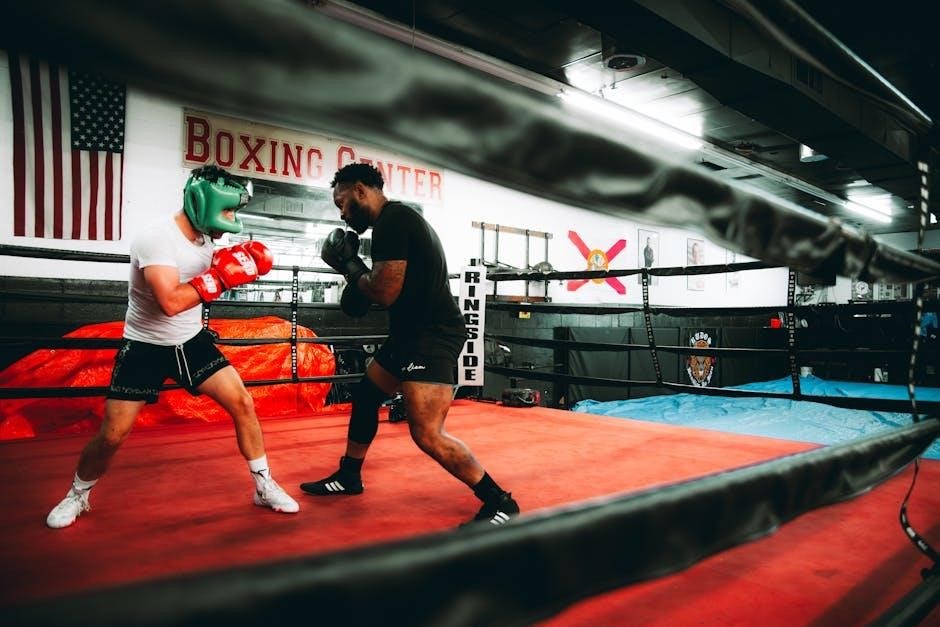
Boxing footwork drills PDF resources emphasize a solid stance, balanced weight distribution, and efficient movement as the foundation for all techniques.
The Boxing Stance and Foot Positioning
Boxing footwork drills PDF guides consistently highlight the importance of a correct stance. Feet should be shoulder-width apart, providing a stable base for movement and power generation. The lead foot points towards the opponent, while the rear foot is at roughly a 45-degree angle.
Weight distribution is key – balanced between both feet, allowing for quick reactions. A slight bend in the knees promotes agility and responsiveness. Maintaining this stance throughout drills, as detailed in many PDF resources, builds muscle memory. Proper foot positioning isn’t static; it dynamically adjusts with each step and movement, enabling efficient transitions between offense and defense. Mastering this foundational element, as emphasized in training materials, is paramount for effective footwork.
Forward and Backward Movement
Boxing footwork drills PDF resources frequently emphasize controlled forward and backward motion. Initiate movement by pushing off the ball of the lead foot to advance, and the ball of the rear foot to retreat. Maintaining balance and the boxing stance is crucial during these transitions.

Avoid crossing the feet, a common error addressed in many PDF guides, as it compromises stability. Small, incremental steps are more effective than large lunges, allowing for quicker adjustments. Drills often involve moving in response to a visual or auditory cue, enhancing reaction time. Practicing these movements repeatedly builds the necessary muscle memory and coordination. Efficient forward and backward movement is fundamental for closing distance, creating angles, and evading attacks.
Lateral Movement (Side-to-Side)
Boxing footwork drills PDF materials consistently highlight the importance of lateral movement for defense and angle creation. The shuffle step, a core technique detailed in these guides, involves maintaining a balanced stance while sliding feet side-to-side. Keep your weight balanced and your hands up throughout the movement.
Avoid crossing your feet, a frequent point of correction in PDF training programs, as it disrupts balance and slows reaction time. Drills often incorporate cone or line work to improve precision and control. Mastering lateral movement allows a boxer to evade punches, circle opponents, and create openings for counterattacks. Consistent practice builds the agility and coordination necessary for effective ring movement.

Essential Boxing Footwork Drills
Boxing footwork drills PDF resources emphasize drills like the pendulum step and shuffle step to build foundational movement skills and agility.
Pendulum Step Drill
The Pendulum Step Drill, frequently detailed in boxing footwork drills PDF guides, is a cornerstone for developing lateral movement. This drill focuses on shifting weight and maintaining balance while moving side-to-side. Begin in your boxing stance, feet shoulder-width apart. The key is to move your feet in a smooth, pendulum-like motion – one foot steps to the side, followed by the other, maintaining a consistent distance between your feet.
Avoid crossing your feet and keep your weight balanced. Many PDF resources suggest performing this drill for multiple rounds, increasing speed and distance with each round; Focus on staying low and maintaining a good defensive posture throughout the exercise. This drill builds the foundation for angling, evading punches, and creating openings for your own attacks, making it essential for any boxer’s training regimen.
Shuffle Step Drill
The Shuffle Step Drill, a common exercise found within boxing footwork drills PDF materials, is designed to improve quick, short-range lateral movement. Starting in the boxing stance, maintain a balanced posture and keep your knees bent. The shuffle involves small, quick steps to the left or right, keeping your feet underneath your hips and avoiding crossing them.
Many PDF guides emphasize maintaining a consistent rhythm and keeping your hands up throughout the drill. Focus on staying light on your feet and reacting quickly to imaginary opponents. This drill enhances your ability to evade punches, close distance, and create angles for attack. Practicing the shuffle step regularly builds crucial agility and responsiveness, vital components of effective boxing footwork, as highlighted in numerous training resources.
In-and-Out Movement Drill
The In-and-Out Movement Drill, frequently detailed in boxing footwork drills PDF resources, focuses on developing the ability to quickly close and create distance from an opponent. Begin in your boxing stance, then practice rapidly stepping forward (in) with one foot and immediately stepping backward (out) with the same foot.
PDF guides often stress maintaining balance and a tight core throughout the movement. Keep your hands up and your weight balanced to avoid being off-guard. This drill improves reaction time, foot speed, and the ability to disrupt an opponent’s timing. Mastering this technique, as shown in various training materials, allows boxers to launch attacks and then swiftly evade counterpunches, a key element of ring strategy.

Advanced Footwork Drills
Boxing footwork drills PDF resources showcase agility ladder work, jump rope exercises, and focused shadow boxing to refine speed and coordination.
Agility Ladder Drills for Boxing
Agility ladder drills, frequently detailed in boxing footwork drills PDF guides, are surprisingly underutilized despite their effectiveness. These drills dramatically improve foot speed, coordination, and quickness – essential attributes for any boxer. Focus on maintaining a low stance throughout each exercise, mimicking the boxing posture.
Common drills include in-and-out steps, lateral shuffles, and Icky Shuffles, each demanding precise foot placement and rapid transitions. The ladder forces boxers to think quickly and react instinctively, translating directly to improved ring movement. Progressive difficulty can be achieved by increasing speed, adding complexity to the patterns, or incorporating boxing-specific movements like pivots and slips between ladder rungs. Consistent practice builds muscle memory and enhances overall footwork proficiency.
Jump Rope Footwork Exercises
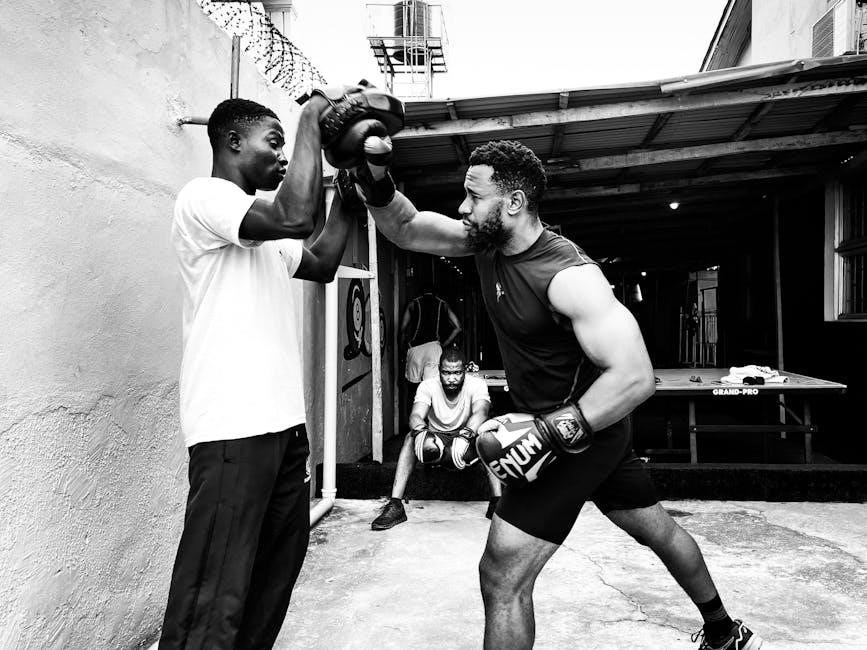
Jump rope exercises, often included in comprehensive boxing footwork drills PDF resources, are a fantastic way to build endurance, coordination, and rhythm – all vital for effective footwork. Beyond basic jumping, focus on variations that mimic boxing movements.
Exercises like alternating foot jumps, high knees, and lateral jumps directly translate to improved agility and quickness in the ring. Incorporating small bounces while maintaining a low center of gravity simulates the constant adjustments needed during sparring. These drills enhance foot speed, timing, and the ability to change direction rapidly. Consistent jump rope training builds calf strength and improves overall cardiovascular fitness, allowing boxers to maintain footwork intensity throughout a fight. It’s a simple, yet powerful, tool.
Shadow Boxing with Footwork Focus
Shadow boxing, a cornerstone of many boxing footwork drills PDF programs, isn’t just about throwing punches; it’s a prime opportunity to refine movement. Dedicate rounds specifically to footwork, visualizing an opponent and reacting accordingly.
Focus on maintaining proper stance, utilizing the pendulum step, shuffle step, and in-and-out movement. Imagine circling, pivoting, and creating angles. Concentrate on smooth transitions between movements, avoiding crossing your feet. This drill builds muscle memory and improves reaction time. Record yourself to identify areas for improvement. Combine footwork with defensive maneuvers like slips and rolls. Effective shadow boxing with a footwork focus translates directly to improved ring performance and control.

Drills for Defensive Footwork
Defensive footwork drills, detailed in many boxing footwork drills PDF resources, emphasize pivoting, angle creation, and distance management for evasion.
Pivoting Drills
Pivoting drills, frequently outlined in boxing footwork drills PDF guides, are fundamental for defensive maneuvers and creating advantageous angles. These drills enhance a boxer’s ability to quickly redirect their movement, evade incoming punches, and reposition for counter-attacks. A common drill involves setting up cones or markers and practicing pivoting around them while maintaining a balanced boxing stance.
Focus should be on smooth, controlled rotations, keeping the weight balanced and the core engaged. Advanced variations include incorporating shadow boxing or light partner work during the pivots. The goal is to develop instinctive pivoting reactions, allowing a boxer to seamlessly shift position and avoid linear attacks. Mastering pivots is essential for ring control and minimizing vulnerability.
Angle Creation Drills
Angle creation drills, detailed in many boxing footwork drills PDF resources, are vital for disrupting an opponent’s rhythm and opening up opportunities for effective punches. These drills focus on moving laterally and diagonally, rather than straight lines, to gain positional advantages. A basic drill involves practicing stepping off-line after throwing a jab or cross, immediately changing the angle of attack.
More complex drills incorporate partner work, simulating an opponent’s pressure while focusing on creating space and circling. The emphasis is on maintaining balance and a tight guard while executing these movements. Successful angle creation forces opponents to constantly adjust, making them predictable and vulnerable to combinations. These drills build ring IQ and offensive creativity.
Distance Management Drills
Distance management drills, frequently outlined in boxing footwork drills PDF guides, are paramount for controlling the range of engagement. These exercises teach boxers to instinctively know when to move in, move out, and maintain optimal striking distance. A fundamental drill involves shadow boxing while consciously varying the distance – practicing quick steps forward to close the gap and agile retreats to create space.
Partner drills simulate realistic exchanges, requiring boxers to react to feints and adjust their positioning accordingly. The goal is to avoid being hit while simultaneously setting up opportunities for their own attacks. Mastering distance allows a boxer to dictate the pace of the fight and neutralize their opponent’s strengths.
Integrating Footwork with Offensive Techniques
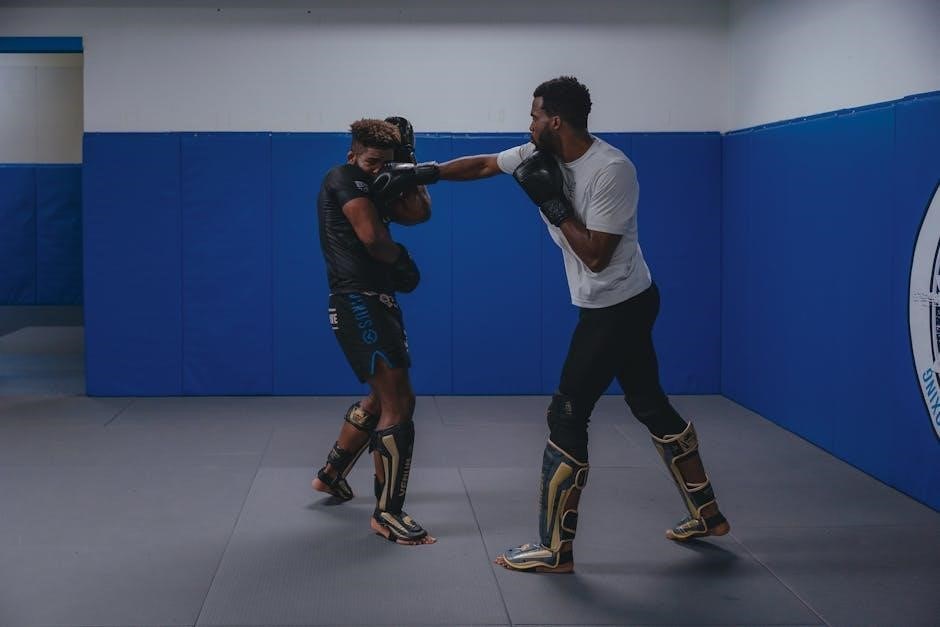
Boxing footwork drills PDF resources emphasize combining movement with punches and combinations for fluid, powerful attacks and improved ring control.
Punching While Moving
Punching while moving is a cornerstone of effective boxing, and many boxing footwork drills PDF guides dedicate significant sections to this skill. The key is maintaining balance and power transfer as you displace your weight. Drills often start with simple combinations – jabs and crosses – thrown while performing shuffle steps or the pendulum step.
Progressing drills involve incorporating hooks and uppercuts, demanding greater core stability and coordination. A common exercise involves moving laterally while delivering a lead hook, then pivoting to throw a rear cross. These PDF resources stress the importance of not “falling into” your punches; your feet should continue to move through the strike, not stop at impact. Focus on keeping your hands up and maintaining a tight guard throughout the movement, ensuring defense isn’t compromised by offense.
Combining Footwork with Combinations
Boxing footwork drills PDF materials consistently emphasize integrating movement with punch sequences. This isn’t simply about throwing punches while moving, but using footwork to create opportunities for effective combinations. Drills often begin with a simple two-punch combo – jab-cross – executed after a shuffle step forward, focusing on maintaining balance and proper form.
More advanced drills involve chaining together multiple movements and punches. For example, a lateral shuffle followed by a lead hook, then a pivot and rear cross. These PDF guides highlight the importance of varying your angles and levels, using footwork to disrupt your opponent’s defense. The goal is to seamlessly blend offensive and defensive maneuvers, making your attacks unpredictable and difficult to counter.
Sparring Drills Focusing on Footwork
Boxing footwork drills PDF resources often transition from isolated drills to controlled sparring scenarios. These aren’t full-intensity fights, but rather focused exercises designed to apply learned footwork principles under pressure. A common drill involves “shadow sparring” where partners move and react without landing full punches, concentrating solely on footwork and distance control.
Another drill limits sparring to specific movements – for example, only allowing lateral movement or requiring a pivot after each combination. PDF guides stress the importance of maintaining the boxing stance, keeping feet shoulder-width apart, and utilizing quick, efficient steps. The objective is to improve reaction time, spatial awareness, and the ability to dictate the pace and angle of the exchange, all while prioritizing footwork fundamentals.

Resources and Further Learning
Boxing footwork drills PDF guides and online video tutorials offer comprehensive training. Explore these resources to refine your technique and elevate your boxing skills.
Recommended PDF Guides for Boxing Footwork
Finding quality PDF guides dedicated to boxing footwork drills is essential for structured learning. Many resources detail fundamental techniques, progressing from basic stances to advanced movement patterns. Look for guides that emphasize the importance of balance, agility, and efficient weight transfer – key components of effective footwork.
Comprehensive PDFs often include detailed drill breakdowns, illustrated step-by-step instructions, and training programs designed to improve speed, coordination, and reaction time. Some guides focus on defensive footwork, covering pivoting, angle creation, and distance management. Others integrate footwork with offensive techniques, demonstrating how to punch effectively while maintaining optimal positioning.
Prioritize guides that offer a holistic approach, connecting footwork to overall boxing strategy. Remember to supplement PDF study with practical application and consistent practice to truly master these vital skills.
Online Video Tutorials
Complementing PDF study with online video tutorials provides a dynamic learning experience for boxing footwork drills. Visual demonstrations are invaluable for understanding proper technique and movement patterns, often clarifying concepts that are difficult to grasp from static images alone. Search for channels featuring experienced boxing coaches and trainers.
Effective tutorials break down drills into manageable steps, showcasing correct foot positioning, body mechanics, and common mistakes to avoid. Look for videos that emphasize the connection between footwork and punching, illustrating how to generate power and maintain balance while moving.
Utilize resources that offer slow-motion replays and multiple camera angles for detailed analysis. Remember to practice alongside the videos, actively applying the techniques demonstrated to reinforce learning and build muscle memory.